

 中文简体
 English
 Español
 русский
How Often Should You Change Media in Cell Culture? A Practical Timing Guide
Your HeLa cells were splitting beautifully yesterday. Today the medium looks pale and slightly yellow, and some cells are pulling away from the flask surface. You check the label: the last medium change was 72 hours ago. Should you replace it again, or is that the moment to subculture? The question of how often you should change media in cell culture is not a one-line recipe. It depends on the metabolic rate of your cells, the buffering capacity of your medium, the culture vessel volume, and the downstream assay you are trying to protect. The practical rule of thumb for most immortalized cell lines is to replace spent medium every 2–3 days, but you should tighten that interval to 24 hours for fast-growing or high-density cultures and extend it to 3–4 days for slow-growing primary or non-dividing cultures. The best way to keep your experiments reliable is to observe, measure, and adapt instead of flushing fresh medium into every flask on a fixed calendar.
The Core Rule: Match the Change Interval to Metabolic Demand
Set a baseline, then refine it. When you seed a T75 flask with a standard immortalized line such as HEK293 or CHO, the medium typically supports cell growth for 48–72 hours before glucose and glutamine become limiting. If you seeded at 20–30% confluency, you can safely wait three days; if you seeded above 50%, expect to change medium within 24–48 hours. A common schedule used in many labs is: fresh medium on day 0, first change after 24 hours to remove dead cells and unattached debris, then subsequent changes every 48 hours until the cells reach the passage target.
Exceptions are routine, not signs of trouble. Fast-growing tumor lines acidify medium in under a day, while suspension cultures in cell culture vessels may need continuous or semi-continuous feeding to maintain pH and oxygen. Pluripotent stem cells are particularly sensitive to spent medium, and daily replacement is standard irrespective of apparent density. The secret is to start with the standard interval, record the growth curve, and adjust only if the data tell you to.
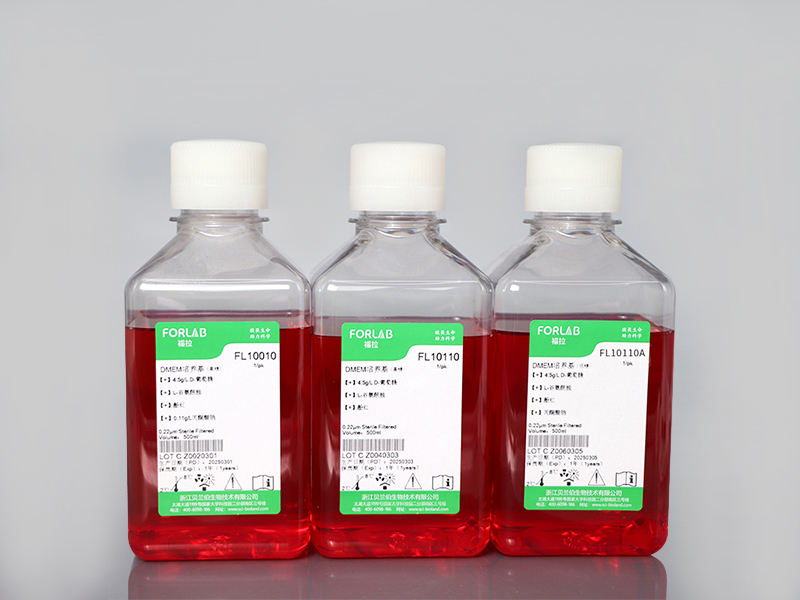 FORLAB DMEM Cell Culture MediumDMEM medium was originally designed with a glucose content of 1000 mg/L (low glucose type), later developed a glucose content of 4500 mg/L (high sugar type), and is no...View Product →
How Cells Tell You It's Time — Visible and Measurable Signals
The medium itself is the first diagnostic. Phenol red shifts from red-orange to yellow as lactic acid builds, and at a pH below 7.0 the color is unmistakable. But color alone is not enough. A healthy culture can show a stable color while still exhausting a key nutrient, and a heavily overgrown culture can retain a reddish tint if the medium has high buffer capacity. Look for a combination of indicators: the color, the morphology of the cells, and the time elapsed since the last change.
| Signal | What It Means | Suggested Action |
|---|---|---|
| Phenol red turns yellow | Lactate accumulation, pH below 7.0 | Change medium immediately |
| Glucose drops below 2 g/L | Nutrient exhaustion | Feed or subculture soon |
| Doubling time slows | Metabolite buildup or nutrient limitation | Change medium and check lot |
| Adherent cells detach | Depleted medium or over-confluence | Subculture, not just feed |
| Color stable but cells sparse | Low metabolic demand | Extend interval to 3–4 days |
In a well-run lab, you can often judge the timing by the color trend over the previous 24 hours rather than a single observation. If the medium was red-orange at the start of the day and is clearly yellow by the afternoon, whatever the cell type, the culture is telling you to act.
Cell Type and Culture System Change the Equation
Adherent, suspension, fast, slow, transformed, primary—these categories set the metabolic demand. But culture format matters just as much. A T75 flask holds about 10–12 mL of medium, while a 96-well plate well holds only 0.1–0.2 mL; in a small well, the surface-area-to-volume ratio is much higher, so nutrients are consumed more quickly. A 2L roller bottle or a cell culture flask stack can support millions of cells and may require daily or even continuous feeding. The table below is a practical starting point for routine work.
| Culture Format | Typical Cell Type | Suggested Media Change Interval |
|---|---|---|
| T75 flask, low density | HeLa, HEK293, fibroblasts | Every 2–3 days |
| T75 flask, high density | CHO, fast tumor lines | Every 24–48 h |
| 96-well plate | Primary or stem cells | Every 24 h for stem cells; 2–3 days for others |
| Roller bottle / cell factory | High-yield production | Daily change or continuous perfusion |
| Suspension flask / spinner | CHO, Sf9 | Every 2 days, or split and feed |
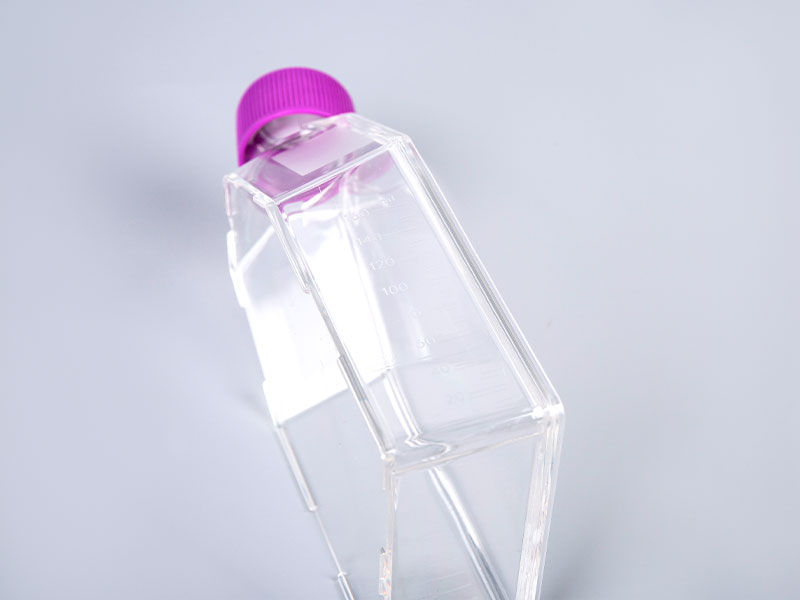 Cell culture flasksBioland™ cell culture flasksThe dead-end bottleneck design greatly ensures a residue-free harvest. The + bottom design makes our bottles smaller. Ultrasonically welded...View Product →
Practical Timetable for Common Cell Types
Instead of searching for one universal interval, build your schedule around the cell type you are maintaining. Use the recommendations below as a starting point, then verify with your specific growth curve.
- Fast-growing immortalized lines (HeLa, HT1080, CHO): change every 24–48 h when seeded above 50% confluency, or every 72 h at lower density.
- Slow-growing normal fibroblasts: every 3–4 days; consider a partial medium change if the culture is sparse.
- Primary epithelial or endothelial cells: every 2–3 days, supplemented with serum as required.
- Induced pluripotent stem cells (iPSCs): daily changes, often twice daily on the day after split, to remove spontaneous differentiation factors.
- Organoid cultures: every 2–3 days, but avoid complete replacement in the first week; partial reinforcement works better.
- Suspension aggregate or bioreactor cultures: daily feeding or continuous perfusion, with regular lactate and glucose measurements.
One more factor to keep in mind: the day of the week. Many labs avoid changing medium on weekends by choosing a seeding density that lets the culture survive two days without a change. If that is not possible, a small amount of fresh medium added on Friday afternoon can often keep the culture healthy until Monday. This does not replace a proper change, but it can prevent starvation when you are away.
For cultures that simply grow too fast, consider reducing the seeding density or using a medium with a stronger buffering capacity instead of increasing the change frequency. That lowers the risk of washing away attachment factors and reduces the chance of contamination from frequent handling.
Replacing vs. Feeding: What Your Cells Actually Need
Partial Change vs. Complete Change
Not every culture needs a complete medium replacement. In low-density cultures, a full exchange can dilute autocrine signals and growth factors that the cells themselves produce. A partial change—removing 50–70% of the spent medium and adding fresh volume—often yields better health and more reproducible results. For high-density production cultures, a fed-batch approach with concentrated glucose and glutamine feeds can maintain viability without the stress of repeated full exchanges. For serum-free conditions, watch for ammonium accumulation; feeding more amino acids than the cells need can raise toxicity rather than improve growth.
Serum and Supplement Quality
The choice of serum is another variable. If you are using a serum-supplemented medium, the serum quality and lot consistency directly affect metabolic demand. Standardized, high-quality fetal bovine serum is the most common supplement, but in a routine partial-change protocol the lot-to-lot variation can shift the optimal interval by a matter of hours. Select a tested and documented serum to keep your schedule reproducible.
 FORLAB Premium Fetal Bovine Serum-Australia/New Zealand OriginContact Us (We will reply you within 12 hours in working day.)View Product →
Final Thought: Build a Habit, Then Adjust It
Media change frequency is a habit that you should keep as stable as possible. Document the seeding time, first change time, and interval used in every experiment. After two passages, look at the growth curve and expression data to decide whether the interval was too long, too short, or just right. A good protocol reduces variability and makes troubleshooting easier. When you choose your reagents and consumables, make sure they do not introduce hidden variations; working with a manufacturing partner that follows ISO-certified processes helps you rule out supplier-related drift before you blame your schedule.
For more information, please call us at +86-0571-87993109 or email us at hzbioland@126.com.
Anyone who has spent time at a cell culture hood knows a quiet truth about the job: the dish is nev...
Walk into almost any molecular biology, IVD, or compound management laboratory and you will find th...
Ask ten labs what the optimal conditions to store cell culture media are, and the answers come back...
Polymerase chain reaction looks like a simple recipe: mix, heat, cool, repeat. In practice, a react...
If you have ever finished a qPCR run, opened the standard curve, and quietly hoped the numbers woul...
Your HeLa cells were splitting beautifully yesterday. Today the medium looks pale and slightly yell...


